A damper designed for the worst case
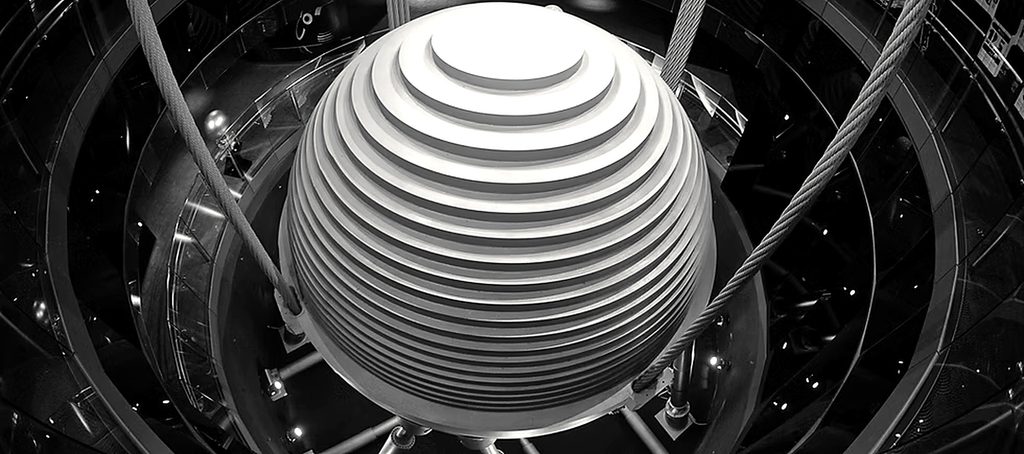
Taipei 101 has a tuned mass damper, a large pendulum hanging from the 92nd floor. It is designed to reduce how far the tower moves in strong wind and during earthquakes. Taiwan gets regular earthquakes and is frequently hit by typhoons, which is why the damper is so large.
The damper is a heavy mass coupled to the structure through hydraulic or spring elements. When the building sways one way, the mass lags behind and pushes against the dampers on the other side. That counterbalance absorbs the building’s energy and turns it into heat.
Motioneering designed the damper and built it with A+H Custom. At roughly 660 tonnes, it was the largest tuned mass damper that Guinness World Records recognized at the time it was built. Motioneering’s own work began with this project: the company says it was invited to design and build the damper in 1999, when Taipei 101 was set to become the world’s tallest building.
What the typhoon tested
The damper has a maximum extension of 1.5 metres. In August 2015, Typhoon Soudelor struck Taipei. According to Guinness World Records, the farthest the damper has swung is about 1 metre, during that storm. It has never reached its design limit.
That is the point worth paying attention to. A damper is designed against assumptions about wind, loads, and the building’s behavior. Whether it performs as intended depends on the wind that actually arrives. A storm that stays within the design envelope is good news, and it still tells you something about how the system is working.
Measuring the response is the other half
Designing the damper is half the job. The other half is measuring how the building actually responds, then using that data to check the design assumptions and set the right operating thresholds.
This is the part of the work Motioneering has done for years. The company describes itself as having designed, constructed, and monitored the full-scale performance of structures and damping systems on every continent, across more than 300 projects. Monitoring during and after strong wind events is how a team confirms that a building behaved as expected, and it gives owners a basis for deciding when systems should respond and when they can keep running.
Where Ibex fits
Motioneering developed the technology behind Ibex, and Ibex applies the same principle to elevators. Elevator ropes and travel cables are long and flexible. In a tall building, they can be set swinging by the structure’s own movement, and in some cases they can strike the walls of the shaft. Many high-rise systems respond by pausing service in strong wind or parking the cars. This is a decision about ride quality and equipment wear. It is not a sign that the building is in danger.
The question for owners and consultants is how that pause is triggered. A rule based only on wind speed will sometimes pause service too early and sometimes too late, because it measures the input and not the response. A response threshold based on measured building motion is more precise. It gives the elevator controller a better basis for pausing service, for the reason that matters.
Motioneering’s damper work shows what a building does with its motion. Ibex measures how the building moves and helps set the thresholds the elevator controller uses to decide when elevators should pause. The elevator OEM decides how the elevators change their behaviour in response. Both depend on measuring the building, not only the weather.
Questions to ask on your next project
- Do we know how the building responds in a strong wind, not just the design-stage prediction?
- What triggers elevator pauses or parking, and is that trigger based on wind speed or on measured building motion?
- Are we measuring during storms, and can we compare the data with the design assumptions afterward?
If wind response is on your next tall-building spec, our team would welcome a conversation. Contact Jackie Hernandez at jackie@ibexelevators.com